
Image credit: pompix / 123RF Stock Photo
In Line Taiwan’s office, developers are watching live baseball matches on their mobile phones.
This kind of behavior is surely unacceptable in some workplaces. But here’s the catch: those developers weren’t slacking off at all. Instead, they were doing research for Line’s newest product – Line Today. A news service built into Line’s main app, Line Today is now available in Taiwan, Thailand, and Indonesia.
Line is headquartered in Tokyo, but it was the company’s Taiwan engineers who suggested the live baseball feature on Line Today. They studied the technicalities behind live casts first before launching it for Taiwanese users, says Rita Yang, senior engineer of Line Taiwan’s engineering team.
“Local engineers would know what’s best for the local market,” adds Marc Lihan, quality assurance (QA) lead of Line Taiwan’s engineering team, which also developed Line Today.
Lihan is a Filipino engineer who used to work at a Japanese IT company. But after the devastating Tohoku earthquake in 2011, he moved to Taiwan. He has been with Line for three years.

Image credit: Line
How Line Today reached 30 million daily pageviews in six months
Line puts development centers in major markets as part of its effort to “culturize” and match its services to local users.
In 2016, the Taiwanese engineering team found out that it was going to develop a proof-of-concept for an in-app news service. The team was understandably elated at the chance to something for the first time: work on a project of its own.
“Before that, we localized services that were developed in other countries. But for Line Today, we had the opportunity to build one on our own [that would be] localized in other countries instead,” says Lihan.
By the end of July 2016, the service had hit 30 million daily pageviews.
Here’s how Line Today evolved. Scroll to see how the service was developed in phases, and read on to learn how the team did it:
With Line Today’s early success, a news tab was added to the main Line app in February 2017. At Line Dev Day 2017, CTO Park Euivin announced that the feature hit 100 million monthly average users and five billion monthly pageviews.
At Line Dev Day 2017, CTO Park Euivin announced a report card of 100 million monthly average users and 5 billion monthly pageviews.
The engineers attribute their success and speed to Agile development processes and good communication.
Line engineers use Agile to ensure the quality of each release and the subsequent side effects, and push fixes. The team, however, doesn’t follow a hierarchical structure. Instead, it prefers to have a leader who guides team members to discover their own work processes. Tasks are also handled differently: instead of being assigned from the top-down, egalitarian task forces are formed to tackle different problems.
On top of maintaining test automation scripts as a quality assurance engineer, Lihan also built the continuous integration/continuous delivery (CI/CD) process – a critical part of Agile. This lets developers “focus on building features rather than spending time on operations,” he says.
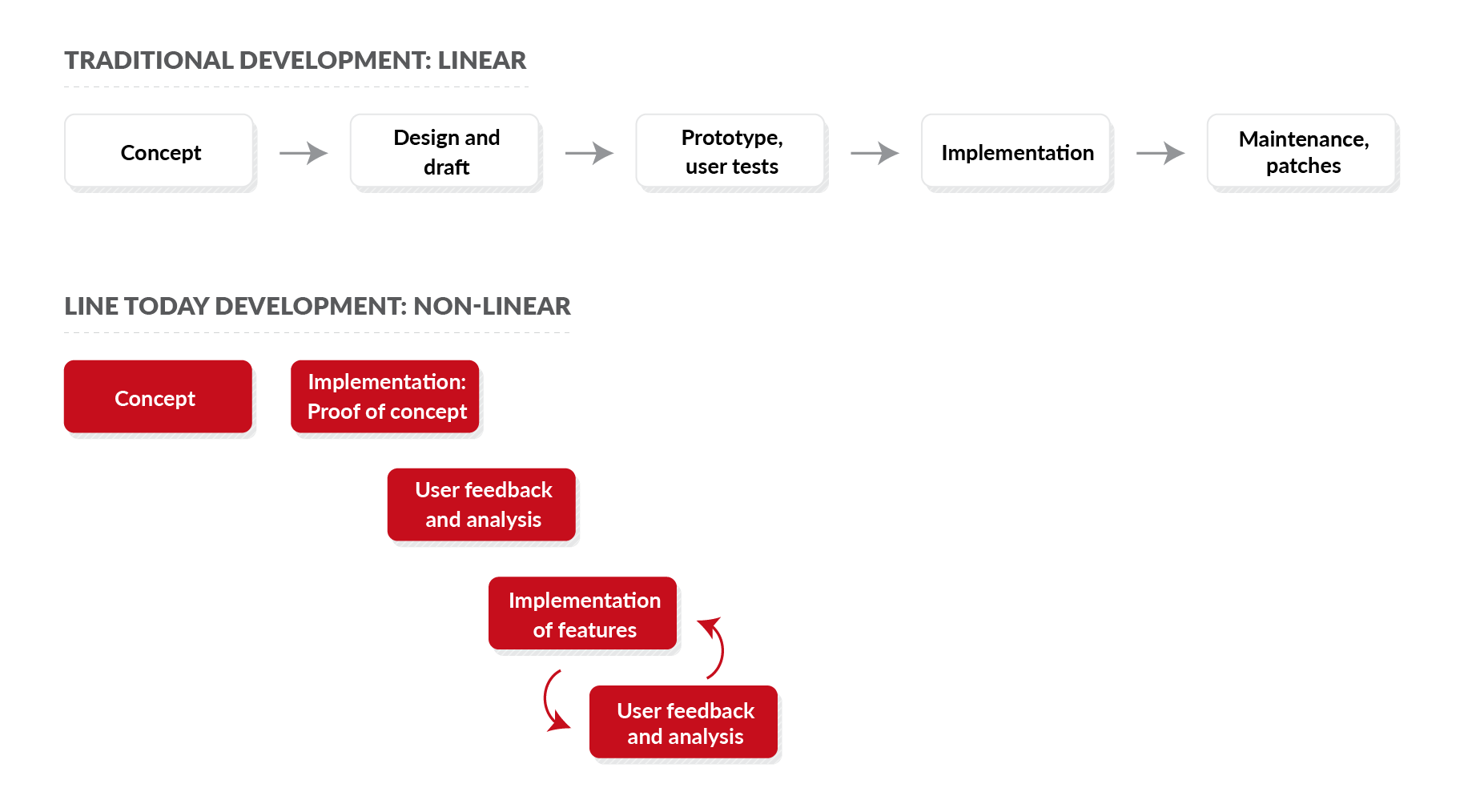
Developing an app need not be a linear process, according to Line / Image credit: Tech in Asia
Agile development across countries
The Taiwan engineers found it challenging to work with engineers overseas to localize the service. The teams in the four countries with access to Line Today speak different languages, and this adds to the complexity of coordinating releases and teamwork.
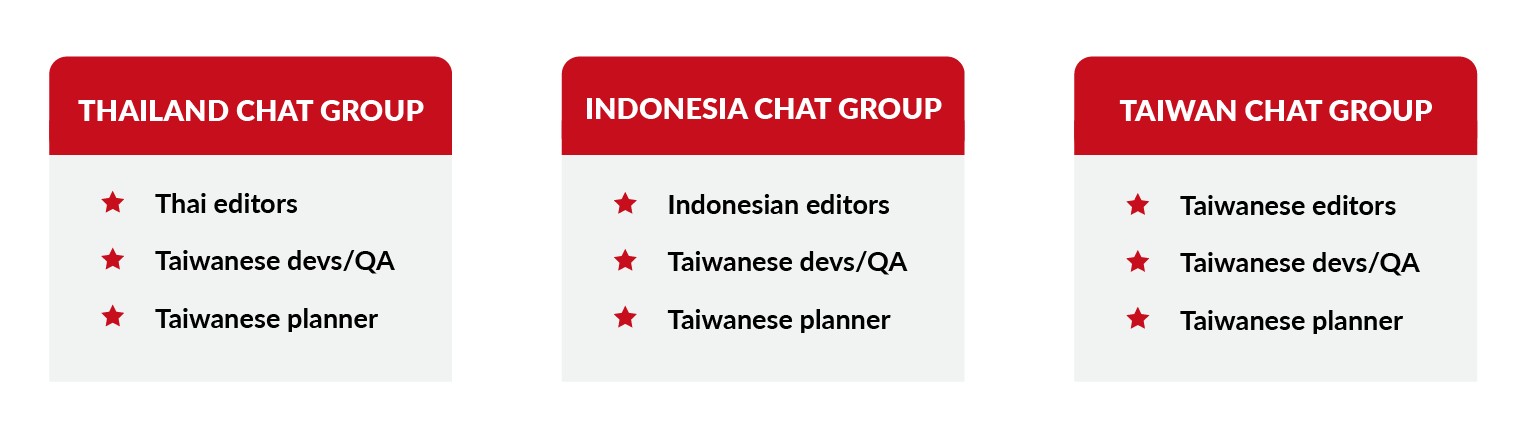
Image credit: Tech in Asia
Each country has its own local task force that provides users with the latest content. But the localized groups also ensure that the local news editors have a direct line to Taiwanese developers to solve urgent bugs. Moreover, the editors can reach out to planners – essentially the developers’ project managers – with feature requests if needed.
The reusability of components in Line Today’s system architecture means that this model can be easily replicated in more countries.
Agile development recommends face-to-face conversations, as they are the best way to communicate. As such, virtual meetings play a large role even if engineers talk in Line chatrooms.
“For urgent or complicated issues, we do video conference calls. If it’s not efficient to use English, we invite interpreters to do live translation during the meeting,” shares Yang.
Line engineers in Thailand, Indonesia, and Taiwan document meeting materials and minutes in an internal wiki page. That way, all engineers can get up to speed.
But even if Taiwanese engineers are leading the project, it doesn’t mean that other engineers elsewhere don’t get to contribute. Anyone can propose new features to planners, who then analyze and convert them to specifications for developers, says Yang.

Line Today is a full-fledged service across countries and languages / Image credit: Line
The Taiwanese team also faced other challenges.
“Most of the developers were rookies unfamiliar with the Line development environments and skills. No one had the experience of handling a new development project, and no one knew the overall process of building a global product,” wrote Lihan on Line’s blog.
The team had to coordinate with developers, planners, QA engineers, UIT (user interface technology) engineers, designers, and even business owners located in Taiwan, China, and Korea.
“Our teams value trust and respect more than anything else. When we assign a task, we know that the engineer can do it,” explains Lihan.
How did the team celebrate their success?
“As we have been breaking records almost every day for the past months, we think it is too early to celebrate,” said Allie Lin, Line’s Taiwanese representative, in an email.
This post How Line engineers in Taiwan hit pageviews out of the park within 6 months appeared first on Tech in Asia.
from Tech in Asia https://www.techinasia.com/line-engineers-taiwan-hit-pageviews-park-6-months
via IFTTT

No comments:
Post a Comment