
Zap’s management team. Photo credit: Zap
Investments today ranged from a pre-seed cash injection into a holiday-booking site to a US$90 million mega-round for a Japanese company that wants to fly to the Moon. Here are the day’s top tech headlines.
Fintech
Zap gets US$550,000 funding for new white-label model (Philippines). Zap started out providing a customer loyalty program that rewarded points which could be used across a range of brand owners. After client feedback the startup shifted to a closed white-label model in 2015, building brand-specific loyalty schemes. Venture Capital Holdings and Kickstart Ventures invested in Zap’s latest funding round, offering a vote of confidence in its pivot and bringing the startup’s total funding to US$1.4 million. (Zap)
Media and entertainment
36Kr Media closes US$45 million series A fundraise (China). Gobi Partners and China Prosperity Capital led the round, with Baidu, Focus Media Information Technology, and Hangzhou Finance Investment Group also participating. Tech news site 36Kr claims it to be the largest investment in a Chinese new media startup to date. (China Money Network)
Candee raises US$21.5 million funding (Japan). Eight Road Ventures led the investment in the livestreaming platform, with Gree Ventures, Mizuho Capital, Opt Ventures, and NTT Docomo also joining in. Candee will use the money to hire more team members, push forward with sales and marketing efforts, and enhance its content offering. (DealStreetAsia)
Aerospace
US$90 million for iSpace to head Moonwards (Japan). The startup is building a lunar rover named Hakuto that it hopes to get into space before the March 31 2018 deadline set by Google’s LunarXPrize competition, in which it is a contestant. Suzuki Motors, Japan Airlines, and the Development Bank of Japan were among the 12 investors that backed the round. (Tech in Asia)

Hakuto lunar rover. Photo credit: iSpace.
Artificial intelligence
Google establishes Beijing AI lab (China). The new research center represents a big investment in China by Google, whose footprint in the country has been limited by the government’s strict censorship rules. (Tech in Asia)
Transportation
Uber picks new country manager (Indonesia). The US ride-hailing company has appointed Monika Rudijono to head its Indonesian business, as competition with regional rivals Go-Jek and Grab intensifies. Rudijono, who currently serves as head of marketing and advertising agency Grey Group, will take up the post next month. (Reuters)
Go-Jek banned from Jakarta school (Indonesia). The Jakarta Intercultural School will not allow Go-Jek drivers to deliver lunches ordered by pupils using the company’s app. The school claims that Go-Jek is endangering students’ health and diverting revenue from its on-site canteen by delivering food from third-party restaurants and takeouts. (Bloomberg)
Grab partners with PayTren (Indonesia). PayTren provides a platform for Indonesians to earn supplemental income through selling things like internet and mobile packages and airline tickets. Its app will be integrated with Grab’s Kudo platform, making Grab driver recruitment an additional service available in the PayTren app. (Grab)
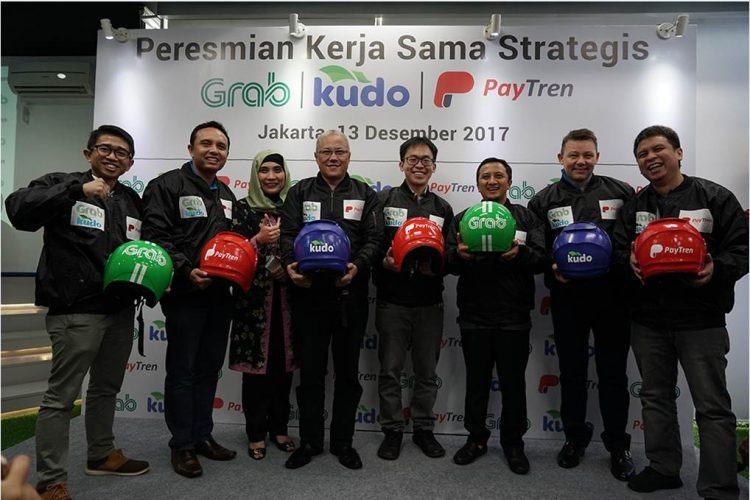
Grab and PayTren executives at the signing of their partnership today. Photo credit: Grab
Ecommerce
Fluent Commerce gets US$4.92 million capital injection (Australia). The startup has developed a cloud-based order management system to help offline brands compete in the online space. Singapore’s Qualgro led the round, with existing backer Blue Sky Ventures and former Hybris CEo Ariel Luedi also participating. (Fluent Commerce)
Adventoro launches with pre-seed funding already in the bag (Malaysia). The discovery and booking portal for adventure-based holidays and activities has announced its official launch after securing an undisclosed amount in a pre-seed funding round. (Adventoro)
Health and wellbeing
DocApp developer secures US$7.2 million in series A round (India). Bessemer Venture Partners invested in Phasorz Technologies alongside Japanese firms DeNA Networks, Rebright Partners, and Techmatrix. Phasorz will use the funds for product development, hires, and to get more medical professionals signed up to use its flagship doctor consultation app DocApp. (Livemint)
Cover-More acquires NUS spinout FitSense (Singapore). Australian travel and health insurer Cover-More Group has purchased a majority stake in FitSense, a health data analytics startup from the National University of Singapore (NUS). FitSense analyzes health and fitness data from mobile apps and connected devices to support customised insurance products. (NUS)
Investors, incubators, and accelerators
SGInnovate names 17 “deep tech” co-investors (Singapore). The tech commercialization agency has appointed 17 regional VC players which it will work with to identify and invest in deep tech startups. Cocoon Capital, NSI Ventures, Qualgro, Vickers Venture Partners, and Wavemaker Partners are among the selected firms. (SGInnovate)
Rakuten teams up with Techstars (Singapore). The Japanese tech giant is launching an accelerator program in Singapore in conjunction with global accelerator network Techstars. The inaugural cohort of 10 startups will be focused on mobile and online messaging and related technologies. (Techstars)
See: Previous Asia tech news roundups
This post Asia tech news roundup – Dec 13 appeared first on Tech in Asia.
from Tech in Asia https://www.techinasia.com/apac-news-13-12-2017
via IFTTT

No comments:
Post a Comment