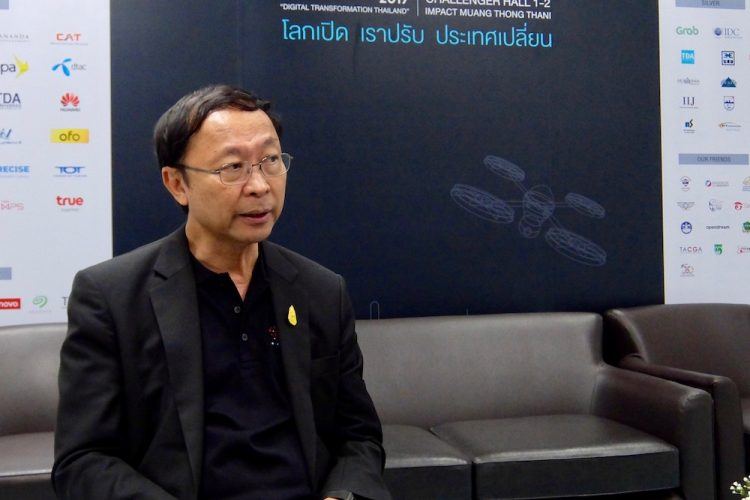
Dr. Pichet Durongkaveroj, minister of Digital Economy and Society. Photo credit: Tech in Asia.
The large conference hall in Bangkok was like set up like a sweeping showcase of 21st-century technology. Drone displays and transforming cars flanked the exhibition while students roared from the e-games contest next to the robotics competition. Not too far away, other students presented hand-made hydroponics systems made of air-conditioning units and LED lights, and a young man led a workshop on how to build apps. Meanwhile, children rode Ofo bikes around a small track at the hall’s perimeter.
Called Digital Thailand Big Bang (DTBB), the four-day event embodied Thailand 4.0 – a government plan that details its vision of the future, one that involves using technology to address the country’s challenges. DTBB, which ran from September 21 to 24, was organized by the Ministry of Digital Economy and Society (DEPA).
The country is in a unique position: being follower to the innovation game, they’re playing catch-up on a nationwide scale. If the event was any measure, the nation’s government is putting their money where their mouth is; a move that, if successful, could make a difference for the local startup ecosystem.
The rise of government funds

A VR exhibition at DTBB. Photo credit: Tech in Asia.
With a young startup scene, the potential for growth is impressive. According to the Tech in Asia database, Thailand went from just six startups getting funding in 2012 to 28 in 2016.
As part of its digital push, the government is promising support for startups. At DTBB, Dr. Pichet Durongkaveroj, minister of Digital Economy and Society, unveiled a new angel fund for early-stage startups. DEPA will raise no less than US$150 million in collaboration with the Stock Exchange of Thailand by the end of 2017.
This news follows the US$147 million Digital Economy Fund announced in June 2017. The reserve will be split between its four objectives: the growth of tech companies, research and development, DEPA operations, and the National Digital Economy Committee expenses.
In 2016, the Ministry of ICT and Ministry of Finance also launched a US$570 million startup venture fund.
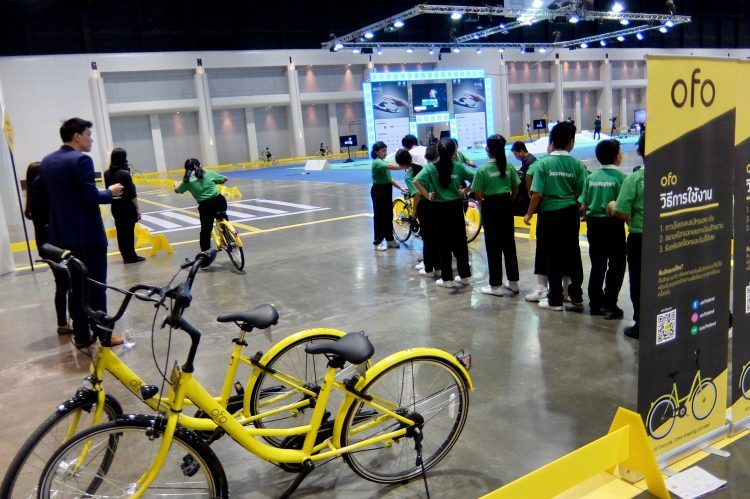
ofo rents bikes out to students within the DTBB event space. Photo credit: Tech in Asia.
Apart from funding, the Thai government wants to improve infrastructure. It is investing $450 million (15,000 million baht) to provide stable wifi connection across the country’s 77 provinces by 2021. It expect to arm 70 million farmers with internet of things technology and implement 10,000 digital points of sale systems across all villages.
This investment will not just supply innovative minds with the right resources but will also go a long way in helping locals solve local problems, according to Durongkaveroj.
“We’ll create a smart city in every province,” he said.

A part of a mockup of Digital Village, Thailand’s newest economic cluster. Photo credit: Tech in Asia.
Efforts to build this vision of the future culminate in Digital Park Thailand, the country’s newest economic cluster. Built in partnership with engineering giant Caterpillar, the US$300,000 project is the size of 80 soccer fields and calls the district of Chonburi its home. It’s located within Thailand’s Eastern Economic Corridor (EEC), which covers three provinces.
A work in progress, the Digital Park will be a smart city that comes with incentive packages, including tax exemptions, smart visas for entrepreneurs and their families, and other privileges for investors and digital specialists.
It’s not about the money

A co-working space set up within DTBB for busy people and tired students. Photo credit: Tech in Asia.
Funding, however, is just a part of a much larger picture. For Monthida McCoole, investment partner at Cocoon Capital, the government push is a great initiative to boost the startup scene’s profile. Aside from increasing funding, events like the DTBB help raise awareness about what startups do – and hopefully to promote their acceptance and understanding in the mainstream. McCoole sees the adoption of a startup mindset as a critical part of an innovative Thailand.
“The whole thing about surveys, customer journey, customer validation, discovery, experimenting, reiterating, fine-tuning — family businesses and SMEs don’t really get that,” said McCoole. “They would execute based on their own assumptions.”
Though these new entrepreneurs are daring and driven, experimentation and hustle are hard to teach, especially in a culture where ‘losing face’ (เสียหน้า sĭa nâa) is a paramount concern. The result is a generation of entrepreneurs who could lose the opportunity to build unicorns.
“When you’re venturing into the unknown – an area that you’re neither familiar nor comfortable with – you need all the help you can get. But culturally, you’d be too embarrassed to ask… you won’t even know where to start.”
This challenge aside, Thailand has all the makings of a strong startup ecosystem. Nati Sang, director of Makerspace Thailand, explained how the country’s culture encourages its people to create.
“[Digital Thailand] is more about unlocking the potential of the Thais in what they’re naturally great at,” said Sang. “When you bring something like the resources of a makerspace into the hands of such people, of course, they’re going to come up with amazing things as long as you develop them right.”
McCoole added, “We’ve made phenomenal progress in the past few years. We’ve got ambition; everyone is doing their part. But there’s a lot more work that needs to be done.”
Work in progress
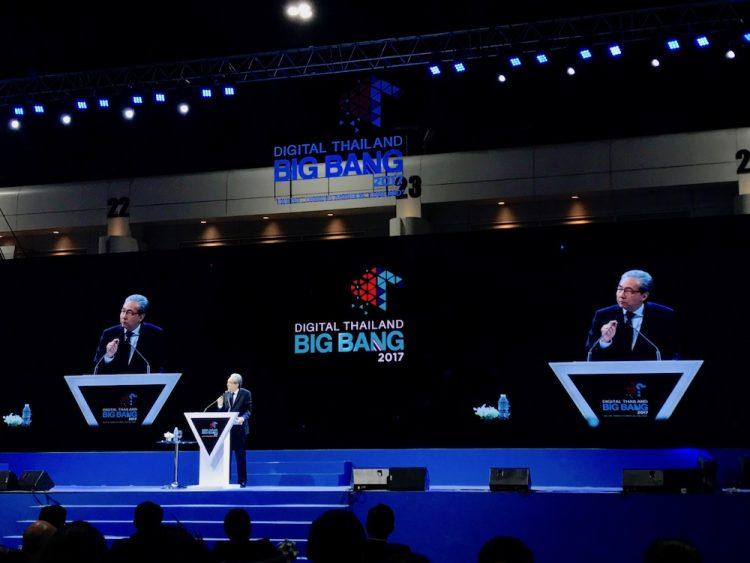
Deputy prime minister Dr. Somkid Jatusripitak shares the Thai government’s vision for Thailand 4.0. Photo credit: Tech in Asia.
Changes won’t happen overnight. The local population needs to improve its digital literacy, and the startup ecosystem must do more to help budding entrepreneurs imbibe the startup mindset. A survey by the Center for Economic and Business Forecasting in Thailand showed that 55 percent of local business owners who responded had little knowledge about Thailand 4.0. Only 1 percent has a deep understanding of it.
As such, going digital isn’t just another way for Thailand to improve itself. It’s imperative to the country’s survival, and this sense of urgency hangs in the air.
But Thailand’s leaders admitted that their vision is a work in progress. At the DTBB’s opening ceremony, Thailand’s prime minister Prayut Chan-o-cha rallied the troops. “Don’t lose faith,” he said. “If we do this together, it is possible.”
On the second day, deputy prime minister Dr. Somkid Jatusripitak was more candid.
“We were once on par with Malaysia,” he said. “Now, we’re 20 years behind, [but] we’re not less capable.”
Jatusripitak went on to throw around buzzwords. IoT. Automation. Reskilling. Disruption. Thinking outside the box. But instead of sounding tedious and overwrought, they serve as Thailand’s guiding stars. “These,” he says, “are the benchmarks of our progress.”
Converted from Thailand Baht. Rate: US$1 to THB 33.2
Held in September 2017, DTBB 2017 brought together tech leaders from around the world to address topics related to smart cities, digital ecosystems, and transformation roadmaps within ASEAN.
Covering the entire digital technology stack, DTBB 2017 delivered the latest products, solutions, knowledge, and innovations to businesses keen to widen their expertise and digital business offerings. For more information on DTBB 2017 and its program, please visit www.digitalthailandbigbang.com.
This post What Thai government’s digital vision means for startups in Asia appeared first on Tech in Asia.
from Tech in Asia https://www.techinasia.com/dtbb-thailands-digital-vision
via IFTTT

No comments:
Post a Comment