
Startups and investors the world over have finally shaken off the dreaded funding winter, if the venture capital deals announced in the third quarter of 2017 are anything to go by.
Globally, 2,362 venture capital deals were revealed in Q3 2017 with an aggregate deal value of US$49 billion, according to alternative assets intelligence firm Prequin. A lion’s share of that money went into Asian tech companies.
- Southeast Asia’s ride-hailing giant Grab nabbed a whopping US$2 billion deal with China’s Didi Chuxing and other investors.
- China’s Toutiao grabbed another US$2 billion from General Atlantic.
- SoftBank invested US$1.5 billion in India’s Flipkart, just a few months after Tencent, Microsoft, and eBay poured around US$1.4 billion into the ecommerce company.
- Ola too raised around US$1.1 billion from SoftBank and other investors.
- So did Paytm, around US$1.4 billion from SoftBank.
The total funding raised by Indian tech companies in the first nine months of 2017 crossed US$9.6 billion across 574 deals, thanks to the three huge checks from SoftBank.
But what about early-stage funding, the better indicator of what verticals are clocking maximum action for tech startups? Tech in Asia asked LetsVenture, an Indian online platform connecting startups to investors. LetsVenture tracked around 1,000 young Indian startups trying to raise funding in the last six months and spotted a 25 percent drop in the number of early-stage financing deals in Q3 2017 compared to Q2. But the average early-stage deal size in Q3 was US$680,000, a 20 percent jump from US$560,000 last quarter.
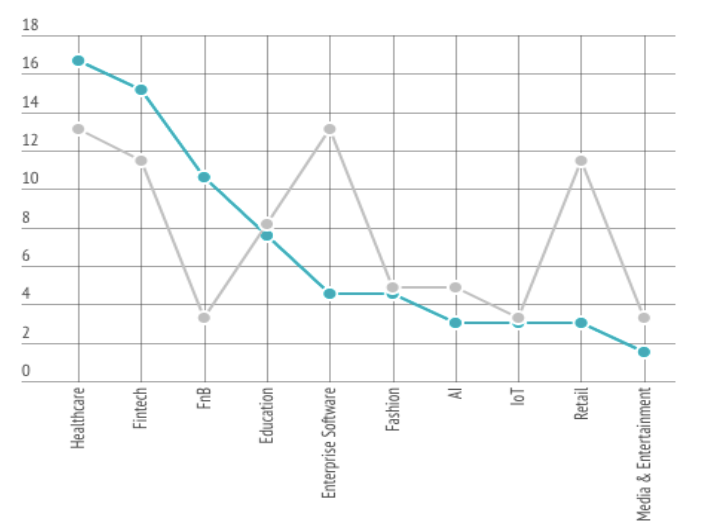
Image credit: LetsVenture. Green graph tracks early stage funding for Q3 2017 and gray graph depicts Q2 data.
LetsVenture tracked all early-stage deals ranging from US$150,000 to US$1.5 million in Q2 and Q3 2017 in the report shared exclusively with Tech in Asia.
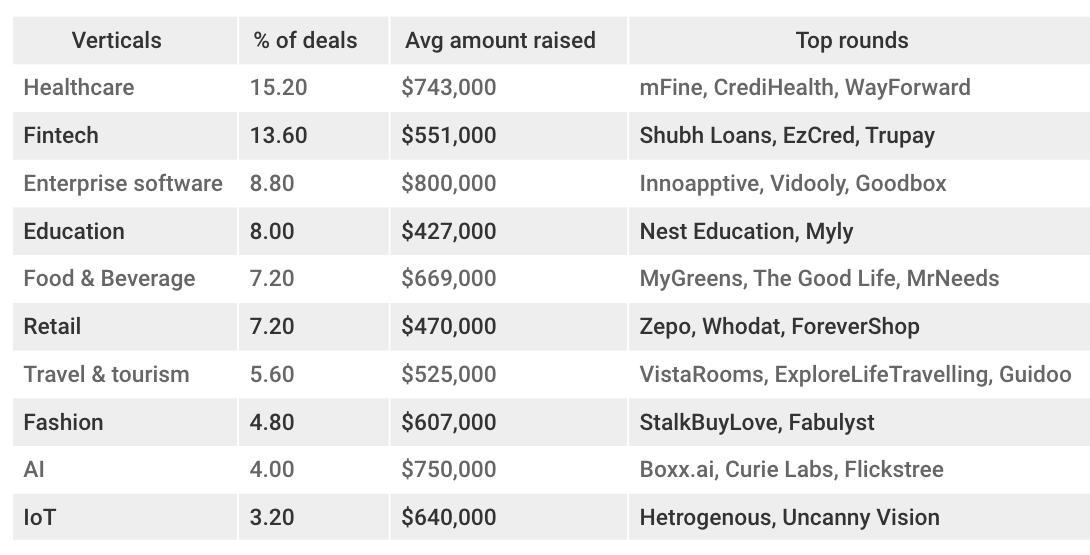
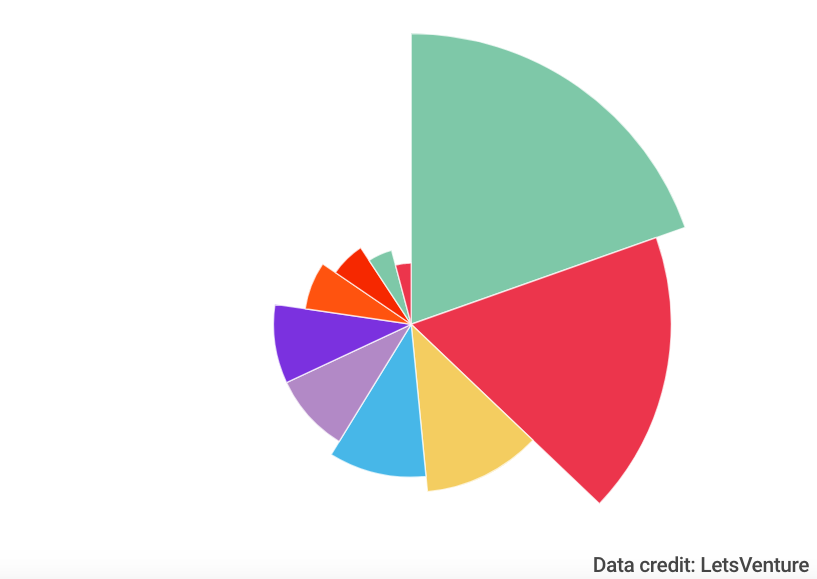
Not surprisingly, the hottest verticals – in other words, sectors that saw maximum number of deals – were healthcare and fintech. Together, healthcare and fintech companies bagged 19 percent of the early-stage funding deals in India. Enterprise software came third with 8.8 percent but with average ticket size of US$800,000, higher than US$743,000 for healthcare startups and US$551,000 for fintech.

What’s new
Tech startups with enterprise software products saw much more interest from investors in Q3 compared to Q2. While the sector was in sixth place in number of deals in Q2, it was number 1 in Q3.
The startups that scored the biggest checks in this vertical are:
- Innovapptive with US$1.5 million from Hyderabad Angels
- Vidooly with US$1.4 million from Gujarat Venture Finance and Times Internet
- Goodbox with US$1 million from Nexus Venture Partners and angel investor Mekin Maheshwari.
Enterprise software includes tech products that improve productivity and efficiency within large organizations. For example, it helps with business intelligence, enterprise resource planning, customer relationship management, accounting, supply chain management, and project and portfolio management. According to Statista, spending on enterprise software is expected to hit US$351 billion by the end of 2017.
Most of the startups in this space operate with the software-as-a-service (SaaS) model. Since 2010, 6,100 SaaS companies have sprouted in India, and 630 of them have raised US$1.98 billion in external capital investment, according to venture capital intelligence firm Tracxn. India’s huge tech talent pool and high capital efficiency are a couple of “unfair advantages” that SaaS startups in the country enjoy.
See: The unfair advantage Indian SaaS startups have over rivals around the world
“With the inbound marketing / inside sales model (most of the selling is done by internet marketing alone), the buying decisions are won by the customer’s perception of the product, his experience, and so on. Nothing is sold by a salesperson convincing a customer to buy,” Suresh Sambandam, founder and CEO of OrangeScape, tells Tech in Asia.
Money power
Fintech saw a fall in the number of early stage funding deals in Q3 compared to Q2, according to LetsVenture data. But there’s enough action in the space to watch it closely.
The Indian government gave a shot in the arm for fintech startups when it announced a sudden demonetization move in November 9, 2016. Higher denomination currency notes of INR 500 (US$7.5) and INR 1,000 (US$15) were abolished, shoving Indians towards a digital economy.
See: Alibaba-backed Paytm is laughing all the way to the bank
“Globally, there has been no disruption in payments and financial systems as big as demonetization has been,” digital payments expert Monica Jasuja wrote, citing several reasons for her opinion.
India’s big push for digital ID Aadhaar was another factor that helped fintech startups.
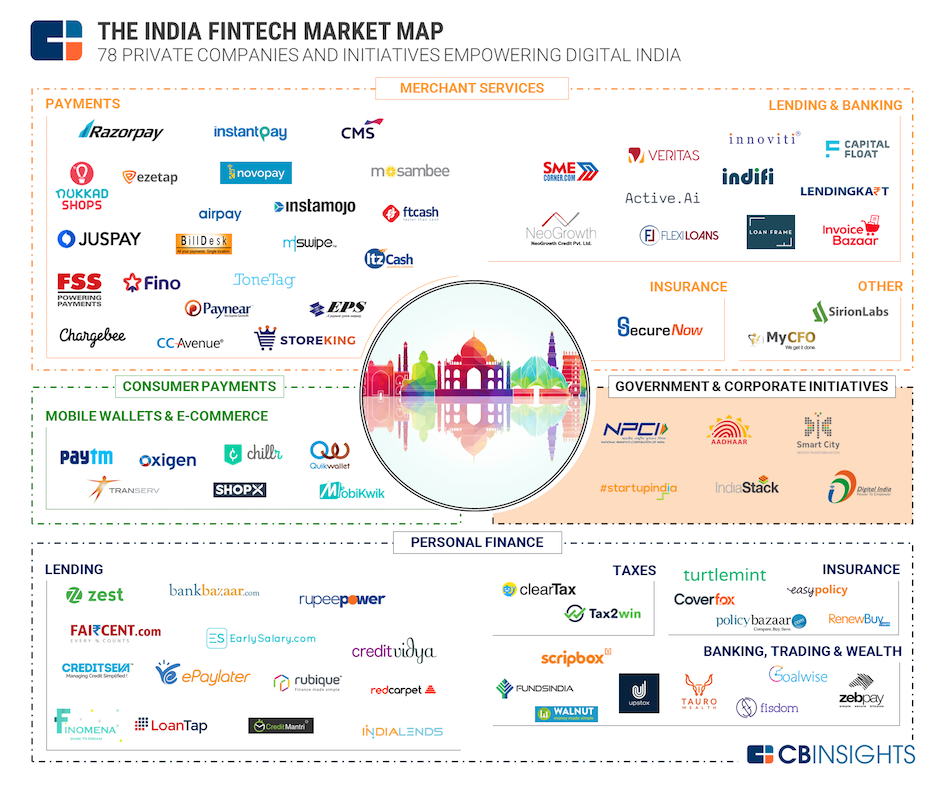
VC database CB Insights mapped the sector, tracking 72 startups working across lending, payments, insurance, and banking.
The early-stage startups that scored the biggest checks in the fintech vertical are: According to LetsVenture data, 67 percent of the early stage deals in the category went to consumer-facing fintech startups.
‘India offers the highest expected return on investment on fintech projects at 29 percent versus a global average of 20 percent,” according to PWC Fintech trends report 2017. “The payments segment has been the most funded within the Indian fintech landscape, riding on the demonetization wave. However, banking technology solutions, including B2B products, are also experiencing strong growth and enabling financial institutions to create seamless solution delivery for end users,” the report said, pointing out the huge opportunity presented by India’s large unbanked or underbanked population, along with its technology and entrepreneurial ecosystem.
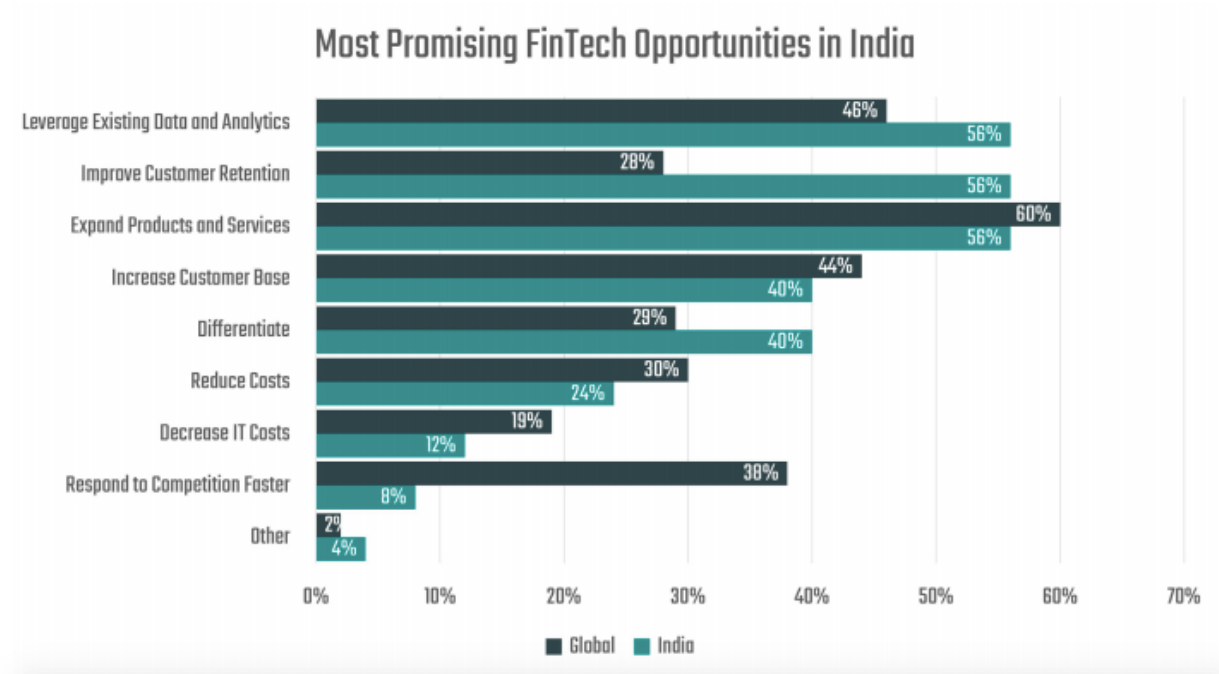
Image credit: PWC Fintech Trends 2017 report.
Health is wealth
Though healthcare didn’t see as much action in Q3 as it did in Q2, the vertical was right on top overall. Primary healthcare alone is estimated to be a US$40 billion market in India. “In addition, some portion of the US$60 billion secondary and tertiary care market is also available for online penetration. By our estimates, no more than US$50 to 60 million of healthcare expenditure (not including pharma sales) is currently online,” writes Ritesh Banglani, co-founder of Stellaris Venture Partners. “The current level of online penetration is miniscule,” he adds.
Banglani is on the board of medtech company mFine, in which Stellaris, along with healthcare entrepreneurs Mayur Abhaya and Rohit MA, invested US$1.5 million a few months ago. Founded by Myntra co-founder Ashutosh Lawania and Prasad Kompalli, a former technology and business head at Myntra, in February 2017, mFine connects patients with doctors for remote consultation. A similar app in Sri Lanka, oDoc too scored US$1 million seed funding in September – the island nation’s largest seed investment round for any startup.
Besides mFine, medical assistant Credihealth, which raised US$1.5 million from Tolaram Group and Mountain Pine Capital, and mental health firm WayForward, which raised US$1 million from angel investors, are two other Indian companies that bagged big early stage checks in this sector.
Food for thought
Not many foodtech startups grabbed investor eyeballs in the last six months. A little over seven percent of the early stage deals went for the vertical. Young startups which raised funding in this space – three quarters of which were consumer-facing businesses – nabbed an average deal size of US$669,000.
Three foodtech startups raised US$1 million in funding are: juice brand Mygreens, premium tea seller The Good Life Company, and online grocer MrNeeds.
The education sector too saw a little funding action with an average deal size of US$427,000. Michael and Susan Dell Foundation and Mahindra Group chairman Anand Mahindra invested US$625,000 in Gurgaon-based startup Nest Education. Jaipur-based school management app Myly raised around US$310,226 from Small Industries Development Bank of India.
Retail, artificial intelligence, travel and tourism, fashion, and IoT (internet of things) are other verticals that LetsVenture tracked in its report.
This article is part of Tech in Asia’s coverage of LetsIgnite, a three-city event by LetsVenture for entrepreneurs and startups coming up in Bangalore, Mumbai, and Delhi. Startups looking to raise funding of US$200,000 to US$1.5 million can apply here.
This post The hottest sectors for venture capital in India this year – surprises, dampeners appeared first on Tech in Asia.
from Tech in Asia https://www.techinasia.com/hottest-sectors-venture-capital-india-2017-infographics
via IFTTT

Hey Nice Blog!!! Thank you for sharing information. Wonderful blog & good post.Its really helpful for me, waiting for a more new post. Keep Blogging!
ReplyDeleteDiabetologists in Navi Mumbai
Informative blog, thanks for sharing such an useful information. Keep it up!
ReplyDeleteDr Sujata Rathod Gynecologist Thane
"Schoollog is a service targeted for schools to enable cloud based school management system and communication between the school and parents.
ReplyDeleteSchoollog was born from the passionate appreciation of the importance of school to parent communication. Due to busy schedule or lack of information to parents, the parent-school connect is lost in the grey. Schoollog increases communication between families and schools, thus making parents play an active role in their ward's education. With a smartphone in every hand, it creates an intuitive and cost-effective way of keeping parents informed. Schoollog also improves school office productivity by reducing paperwork and unnecessary phone calls.
Its one of the best School Management Software available in Indian Markets. "