
Photo credit: Victor Björkund.
Interactivity is the lifeblood of live streaming. That’s what powers its monetization model in China, where audience members shower live streaming hosts with virtual gifts in exchange for attention and entertainment. Live streaming in the classroom, however, is a slightly different story.
“In the past few months, there [have been] a lot of doubts about what kind of role live streaming can play in education,” says Lu Jian, president of CCTalk Cloud, the live streaming arm of Chinese education company Hujiang. “A lot of people […] think it’s a fad.”
“However, I think it’s because of the misunderstanding of [how] live streaming for entertainment is different from live streaming for education,” he tells Tech in Asia.
CCTalk is part of a growing number of live broadcasting services in China’s education industry. Similar to entertainment and ecommerce applications of live streaming, educational live streams open a real-time channel between a host and an audience, or – in education vernacular – a teacher and students.
The key difference, however, is in host and audience interactions. On CCTalk, for example, virtual gifting is not encouraged. Beautifying effects, such as filters that make your eyes bigger, are also non-existent. Instead, there are tools that are familiar to anyone who’s tried MOOCs like Coursera and Udemy. Teachers can share their screen with students and write on a virtual whiteboard. To prevent CCTalk students – as many as ten thousand in a single class – from drowning out their classmates or teacher, students have to ‘raise their hand’ to participate.
Even though the classes are less polished – teachers can’t edit footage – live courses feel more authentic, says Lu Jian.
“I think live courses […] are more popular because they are more similar to the experience of the classes that we all have experience with,” says Lu Jian. “The teacher is teaching on the stage [and] we can interact with him or her.”
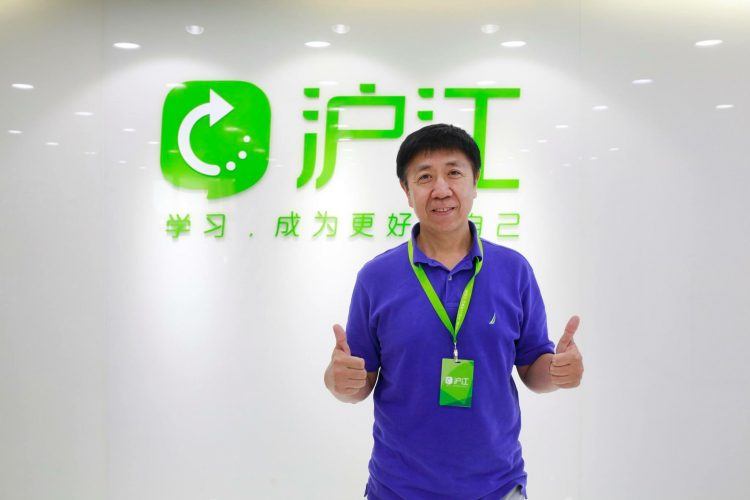
Lu Jian, president of CCTalk Cloud. Photo credit: Hujiang.
The company plans to add more live interaction features in the future, such as pop quizzes and in-class vocabulary games. Because classes are live, interactions can be more dynamic, says Lu Jian.
Currently, Hujiang has over 10,000 individuals and organizations teaching classes on CCTalk. Though most classes are free, some teachers are making more than US$200 per class. Unlike Hujiang’s MOOC-like video classes – the company’s main revenue stream – CCTalk has no restrictions on content or teaching experience. Anyone can register as a teacher and start broadcasting live.
MOOC+?
Hujiang is not the only company implementing live classes. Larger players, such as Tencent and YY, have their own live education platforms as well. Their product offering is almost identical – open platform, shared screen capabilities, education-specific interactions – which means content and reach will be key differentiating factors. No doubt each company has been able to leverage the hype around live streaming in China this year.
However, at the moment it’s not clear whether live classes offer anything new to the edutech industry. With virtual whiteboards and screen-shared powerpoint slides, they look very similar to traditional online courseware. Adobe Connect, for example, even has a little ‘hand raising’ button so students don’t talk over each other.
Still, it’s worth noting that student attrition – the Achilles’ heel of MOOCs – might be mitigated if edutech companies can make live classes more engaging for students. For now, Hujiang will rely on external factors, such as acing the TOEFL to study or work abroad, to drive student motivation.
“In our case […] most of the students have strong motivation,” says Lu Jian. “They are not studying for fun.”
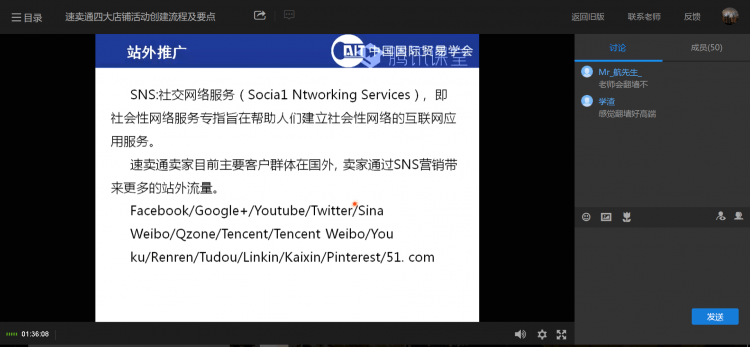
A live class about cross-border ecommerce on Tencent’s platform.
This post Live streaming in the classroom: fad or real value? appeared first on Tech in Asia.
from Tech in Asia https://www.techinasia.com/live-streaming-education-china
via IFTTT

No comments:
Post a Comment