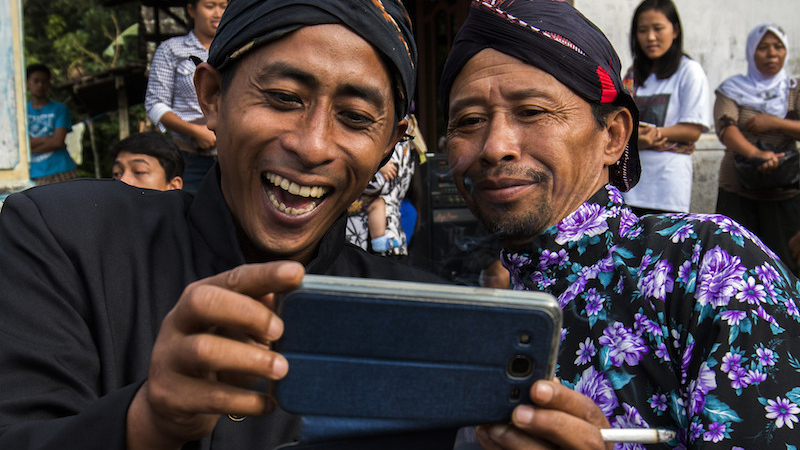
Photo credit: Eko Susanto.
Here’s how to think about the maturity of an app economy.
In stage one, app usage is tethered to how fast people are upgrading their old phones to smartphones.
“If the install base of mobile devices is growing, what tends to happen is downloads go through the roof. In Indonesia, downloads doubled over the past two years. It’s the number six country in terms of downloads, globally,” says Danielle Levitas, who heads research and marketing at app analytics company App Annie.
In Indonesia, the upgrade to smartphones is now in full swing. According to Danielle, the country is still in the early stage of the app economy, but tipping over to phase two.
“Next, consumers start developing habits, they settle on which games they like, which shopping and ride-sharing apps.” This is when time spent in-app becomes more relevant. “In Indonesia, time spent in apps grew by about 85 percent last year,” Danielle says. “Globally it grew faster.”
In stage three it’s all about monetization. Markets like China are the largest.
Here it’s still early, greenfield opportunity – which means it’s a good time for local players to get in position to become leaders in certain app categories.
The categories that are popular – like messaging, shopping, travel, or transport – are pretty much the same across the globe, Danielle says, interviewed today by Tech in Asia’s Nivedita Bhattacharjee at TIA Jakarta 2016.
It’s within these categories that you see local flavor and jockeying for top positions. In Indonesia, messaging apps BBM and Line are bigger than in most western countries, but Whatsapp and Facebook Messenger are also popular. In the transport category, Go-Jek and Grab are ahead of Uber, which means Indonesians favor their local and regional heros and see more value in them.
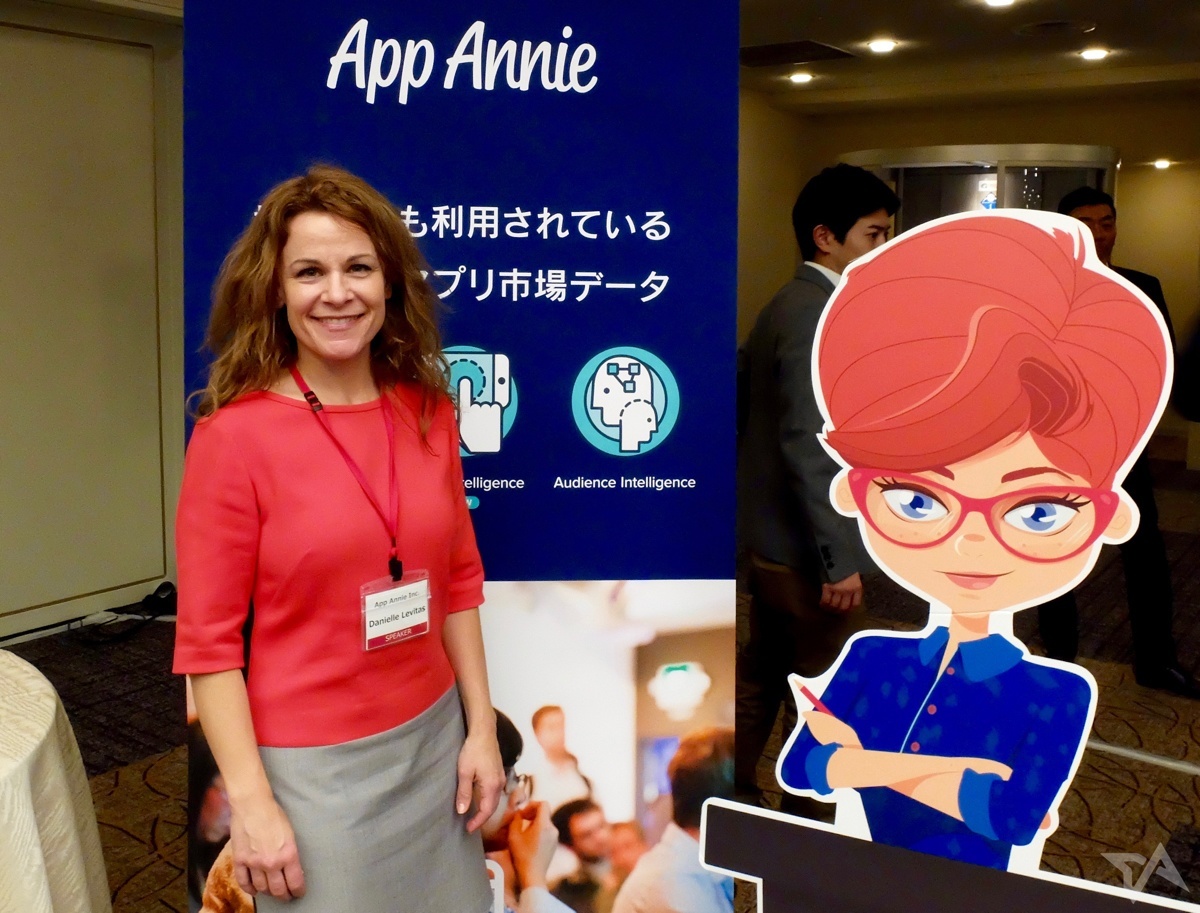
App Annie’s Danielle Levitas.
How to bootstrap an app marketing strategy
But how do you get on people’s smartphones in the first place? It all depends on how much cash you have. “If you are well funded, you can drive paid marketing, rise in the ranks, and then you can get to organic users from there,” Danielle explains.
Bootstrapped startups have a fighting chance if they play their cards right.
“The free side of marketing, like search engine optimization – in the app store world we call [it] app store optimization – or ASO,” Danielle says. “What titles, description, and creative you use for your app can affect your position in the app store.”
She recommends using an ASO tool to understand which search terms are popular and to craft your app presentation based on that knowledge.
“I’m a big believer in A/B testing. Did this one description help more than the others?”
Competitive analysis is another strategy that helps app businesses with a small budget.
“Let’s say a competitor did something like integrate a new payment system. Did this move them up in the ranks or their numbers of weekly active users?”
So you can learn from studying indirect or direct competitor’s moves closely.
Good UX is everything
What’s absolutely necessary for a lesser known brand is a good user experience.
“UX is everything,” Danielle says. “Do everything you can to reduce friction. Optimize for fewer clicks to get to the end goal, no matter what that goal is, whether buying something or accessing content.”
“If you’re a great brand people will forgive user experience sins. If you’re not a major brand you don’t have that luxury.”
Know your KPIs and build models
For sustainable success as an app business, it’s imperative to understand the key performance indicators most relevant to your business.
“Some of the KPIs are the same for every business, like downloads are of course a benchmark,” says the App Annie expert. “But beyond that, it could be about total time spent in app, if you are in entertainment, If you’re a transactional app [like Uber], it’s more about sessions than total time spent.”
Danielle recommends creating models to figure out what needs to happen for your app business work. “It’s simple. How much cash do you have? How many monthly active users do you need at which lifetime value?”
Lifetime value refers to the total amount of money you expect a user to spend on the app from the time they sign up until they become inactive.
Apps are here to stay
One metric in particular makes Danielle optimistic about the future relevance of apps in our daily activities as communicators and consumers.
“53 minutes per mobile hour is spent in app vs in browser,” she says. This means that out of the time people spent glued to their devices, they’re engaging in apps the vast majority of the time.
Apps have another significant advantage over browser-based apps: notifications.
“The right message at the right time can make a dramatic difference, you can drive customers back into the app. Optimize heavily for this.”
This is part of the coverage of TIA Jakarta 2016, our conference taking place on November 16 and 17.
This post How to win in the app economy on a bootstrap budget appeared first on Tech in Asia.
from Tech in Asia https://www.techinasia.com/how-to-win-in-the-app-economy
via IFTTT

No comments:
Post a Comment